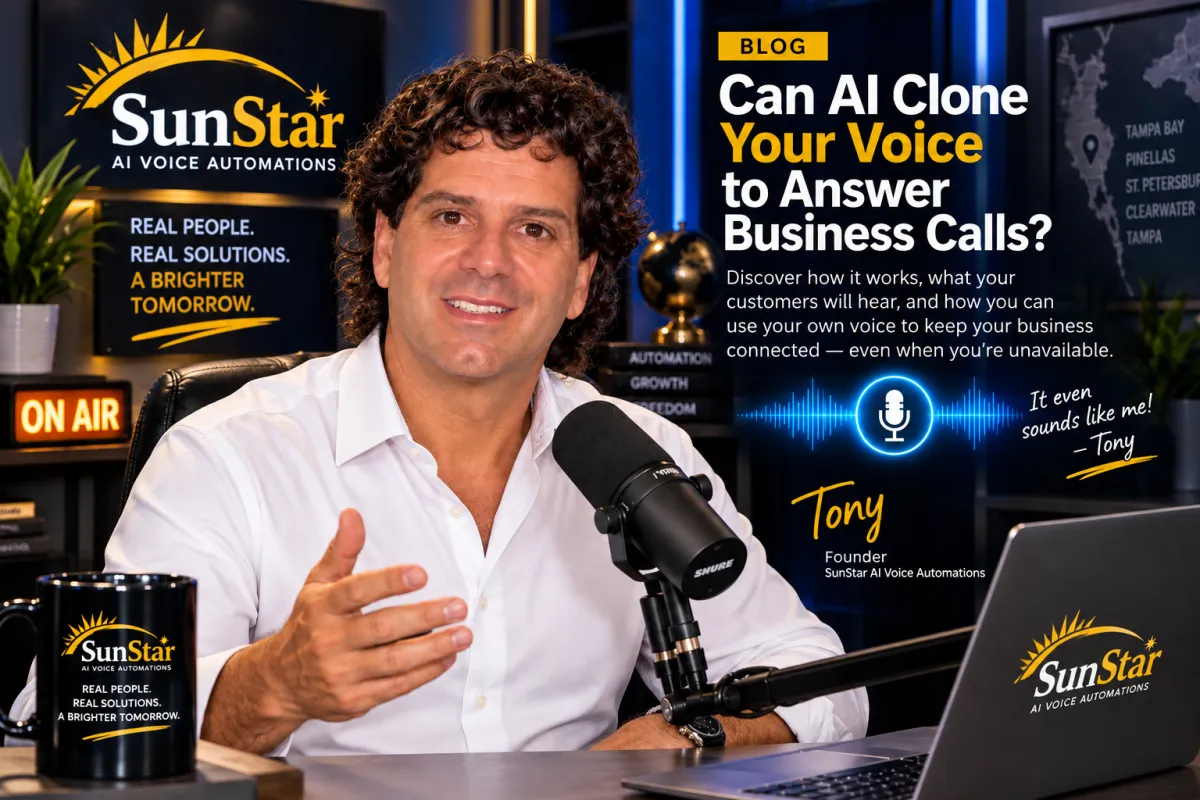
Can AI Clone Your Voice to Answer Business Calls?
Imagine a customer calling your business after hours and hearing a familiar voice—your voice—even though you're not the one answering the phone.
AI voice cloning makes that possible.
Instead of choosing a standard synthetic voice for your AI receptionist, you can create a digital voice based on your own speech. When configured with an AI phone assistant, that voice can answer questions, collect customer information, and help schedule appointments.
But how does it actually work? Does it sound like you? And what should business owners know before using it?
Let's break it down.
What Is AI Voice Cloning?
AI voice cloning is technology that creates a synthetic version of a person's voice using recordings of their speech.
The system analyzes characteristics such as:
Tone and pitch
Pronunciation and accent
Speaking rhythm and pacing
Other distinctive vocal characteristics
The resulting voice model can generate new speech that resembles the original speaker.
That means an AI assistant can say sentences you never personally recorded while using a voice modeled on yours.
Important: Cloning a voice and building an AI receptionist are two different things. Voice cloning creates the sound of the voice. The AI receptionist handles the conversation and performs the configured business tasks.
When combined, they allow an AI receptionist to speak using your authorized digital voice.
How Does AI Voice Cloning Work?
The process generally involves four steps.
Step 1: Record your voice
You provide a recording of yourself speaking.
The recording should be clear, with minimal background noise. The amount of audio required depends on the voice-cloning technology and the quality of the result you want.
Some systems can produce a preliminary voice from a short sample, while others benefit from longer recordings.
Step 2: Create the voice model
The voice-cloning system processes the recording and creates a digital model that captures recognizable characteristics of your speech.
Step 3: Test the cloned voice
You listen to generated speech and check whether the pronunciation, tone, and overall sound meet your expectations.
A cloned voice may need adjustments or additional recordings to improve its quality.
Step 4: Connect the voice to your AI receptionist
Once the voice is ready, it can be configured as the speaking voice for a compatible AI assistant.
The receptionist then uses that voice to deliver greetings, respond to callers, and communicate information according to its configuration.
See It in Action: AI Tony's Voice-Cloning Demonstration
This is where technology becomes much easier to understand.
Rather than simply describing voice cloning, I created an AI version of my own voice so business owners can hear an example for themselves.
In the demonstration below, you can hear how AI-generated speech can resemble a real person's voice.
[INSERT YOUR AI TONY VOICE-CLONING VIDEO HERE]
Demonstration: AI-generated speech using an authorized digital version of Tony's voice. Results vary depending on the recording, voice model, and system configuration.
The important distinction is that the demonstration illustrates the voice itself. Connecting that voice to a fully configured AI receptionist is what enables actual call handling.
What Will Customers Hear?
When a customer calls a business using a cloned voice, the AI receptionist can greet them in a voice designed to resemble the business owner.
For example:
"Thank you for calling. How can I help you today?"
The caller might then ask about services, request an appointment, or explain why they're calling.
Depending on how the system is configured, the AI receptionist can respond using the cloned voice while collecting information or performing supported tasks.
A realistic voice does not guarantee a perfect conversation. The experience also depends on the AI assistant's knowledge, instructions, integrations, and ability to handle unexpected questions.
Businesses should clearly identify the assistant as AI rather than misleading customers into believing the owner is personally speaking.
Why Would a Business Owner Clone Their Voice?
For some business owners, their voice is part of their brand.
Customers may recognize the owner from phone calls, videos, radio advertising, or personal interactions.
Using an authorized digital version of that voice can help create a consistent audio identity across automated interactions.
Here are several possible applications.
After-hours call answering
An AI receptionist can greet callers after the business closes, gather their information, and help arrange follow-up.
The owner does not have to answer every call personally.
Busy or unanswered calls
When the owner is working with a customer or cannot pick up the phone, an AI receptionist can handle calls routed to it.
Appointment requests
With the appropriate calendar integration and permissions, an AI receptionist can check availability and help schedule appointments.
Frequently asked questions
The assistant can provide approved information about business hours, service areas, and available services.
A consistent brand voice
Businesses can use an authorized voice model to create a recognizable sound for their automated phone interactions.
Voice cloning is optional. A business can use a standard AI voice and still receive the same underlying receptionist functionality.
Is AI Voice Cloning Safe?
Voice cloning requires responsible handling because a recognizable voice can be misused to impersonate someone.
A business should use only a voice it owns or has explicit permission to reproduce.
Before creating a voice model, establish:
Who has authorized the voice to be cloned
Who can access and use the model
Which business applications are permitted
How the recordings and model are stored
How access can be revoked or the model deleted
How callers will be informed that they're speaking with AI
Security and privacy protections depend on the provider and the specific service agreement. Do not assume that every voice-cloning platform offers identical safeguards.
At SunStar, the appropriate starting point is using your own voice—or another person's voice only with their explicit authorization.
Will Customers Know They're Speaking With AI?
They should be informed.
A business can use a natural-sounding cloned voice while still making it clear that an AI assistant is answering.
For example:
"Hi, you've reached SunStar. I'm Tony's AI voice assistant. How can I help you?"
This gives callers a clear understanding of the interaction without sacrificing a professional greeting.
Depending on where the business operates and how calls are recorded or used, additional disclosure and consent requirements may apply.
Can a Cloned Voice Book Appointments and Answer Questions?
Not by itself.
The voice model determines what the assistant sounds like. The AI receptionist and its integrations determine what it can do.
A properly configured system may be able to:
Answer incoming calls
Ask customers why they're calling
Collect names and contact information
Explain approved services
Check connected calendar availability
Schedule supported appointments
Send notifications or follow-up information
Transfer or escalate calls when configured to do so
The available capabilities depend on the actual setup.
Think of it this way:
Voice cloning provides the voice. The AI receptionist provides the conversation and workflow.
Do You Have to Clone Your Voice to Use an AI Receptionist?
Absolutely not.
Many businesses prefer a professionally designed AI voice.
Voice cloning is an additional personalization option for owners who want their automated assistant to have a voice associated with their business.
The decision depends on your branding preferences, privacy requirements, budget, and the customer experience you want to create.
Frequently Asked Questions
Can AI really sound like my voice?
Yes. Modern voice-cloning systems can generate speech resembling a person's voice, although quality varies by provider, recording quality, and voice model.
Do I need professional recording equipment?
Not always. Some systems can work with clear recordings made using ordinary equipment. A quiet environment and clean audio generally improve the source material.
Can the AI say things I never recorded?
Yes. A voice model can synthesize new speech rather than simply replaying prerecorded phrases.
Can someone clone my voice without permission?
Voice-cloning technology can be misused. Businesses should select providers with appropriate authorization, access-control, and security practices and should never clone someone else's voice without permission.
Does voice cloning automatically answer my business phone?
No. You need a compatible AI receptionist and phone integration. The voice model alone does not answer calls.
Can I use a regular AI voice instead?
Yes. Voice cloning is optional.
Give Your Business a Voice That Works Even When You're Unavailable
Your voice can be an important part of how customers recognize your business.
AI voice cloning offers a way to extend that recognizable sound into automated conversations, while an AI receptionist handles the actual call-answering tasks.
At SunStar AI Voice Automations, we help businesses explore AI voice assistants, call handling, appointment booking, and voice personalization.
Want to hear what an AI version of your voice could sound like?
Contact SunStar to discuss voice cloning and how it could work with your business's AI receptionist.
Voice cloning requires authorization. Features, voice quality, and available integrations depend on the selected service and configuration.